University of Toronto
Most governments in industrialized countries, supported by business interests and parents, have placed a high priority on introducing information technology (IT) into their schools. The assumption appears to be that IT is an integral part of the new economy of the 21st century and therefore it should be an integral part of the school systems that are supposed to prepare students for this new economy. There has been considerable discussion in North America regarding the wisdom of this direction. Critics argue that there is little evidence that IT improves students’ school achievement in any significant way and they point to the diversion of scare resources from other subject matter, such as the arts and literature, considered marginal by those who adopt an economically-oriented perspective on education. However, these criticisms have had little impact and the introduction of IT in schools gains momentum with every passing year.
Despite the increase in access to IT in schools, there is still no consensus as to how computers should be used to support learning. For example, schools in affluent middle-class areas increasingly tend to use computers to support higher-order thinking through creative project work while those in low-income inner city areas still use computers predominantly to reinforce students’ mastery of basic skills through drill and practice activities.
The perspective of this paper is that IT can play a significant and positive educational role, but only if the pedagogical possibilities of IT are clearly understood. I distinguish between three pedagogical orientations, traditional, constructivist/progressive, and transformative, and suggest that the potential of IT is most clearly evident when schools adopt a transformative pedagogical orientation. I then describe a general pedagogical framework and highlight how IT can amplify the impact of second language learning in the context of sister class networks where students in different geographical locations carry out joint projects together using the Internet and World Wide Web to access both people resources and information resources.
Three broad orientations to pedagogy can be distinguished in recent educational debates (see Cummins, 1998, 2000). Within traditional pedagogy the focus is transmission of information and skills. In the case of second language teaching, this implies teaching language structures and forms with little emphasis on internalization of meaning or active communicative/authentic use of the language. Traditional pedagogy is exemplified when students learn predominantly from the textbook. Within this orientation, IT would be used to reinforce the learning of content or vocabulary and grammatical knowledge. The format is frequently made more appealing to students than the textbook format by means of interactive games and activities but the basic aim is to reinforce information and skills. Computers and other forms of IT can also reinforce phonological awareness (e.g. pronunciation) in the second language much more effectively than the textbook as a result of their sound capabilities and ability to provide individual feedback to students. However, these drill and practice activities imply that students have individual access to the computer and few schools in North America or elsewhere have more than one or two computers per classroom and the high cost of hardware and software means that this situation is unlikely to change significantly in the next decade.
In one NASA project I did with my 4th and 5th graders called Marsville, we connected with other classrooms online to design a Marsville City. (www.challengercenter.org/tr/tr_prpro_set.htm). Marsville was a project-based activity where students created a prototype habitat for Mars. The children came together to learn and build their city and make their own living spaces using a variety of interdisciplinary skills. In the process, they learned creative problem-solving, cooperative learning and data analysis. We studied the systems needed to survive on Mars. We did not just read about it, we did it! It was exciting to see how such a project engaged my immigrant students who were still learning English, and motivated their reading and science learning. (Bracey, 2000, pp. 4-5).
This example clearly involves higher-order thinking skills and cognitive challenge. It also is likely to be much more highly motivating for students than simply learning about Mars or human habitats from a textbook. The active, hands-on, cooperative activities also appeared to be cognitively engaging and motivating for students who were learning through a second language. In this case, students are learning both scientific content and second language structures and functions simultaneously.
The instructional assumptions of transformative pedagogy are similar to those of constructivist/progressive pedagogy. However, they diverge with respect to social assumptions. Transformative pedagogy uses collaborative critical inquiry to enable students to analyze and understand the social realities of their own lives and of their communities. Students discuss, and frequently act on, ways in which these realities might be transformed through various forms of social action. Thus, the focus is on constructing meanings, cognitive challenge, and dynamic support within the zone of proximal development. However, the content for investigation and inquiry has social relevance related to the power structure in society. For example, within a transformative pedagogical orientation, the Marsville project described by Bracey (2000) might be followed up by a project that examines the problems of human habitats on earth and the causes of these problems. Students might design an urban habitat on earth that avoids current urban problems (e.g. homelessness, violence, poverty, pollution, etc.). This would require that students research and analyze sources of inequity in income, causes of pollution, etc. and discuss how these problems can be resolved.
A variety of case studies of computer-mediated sister class networks that employ a transformative orientation have been described by Cummins and Sayers (1995). However, the use of IT within this orientation is still relatively uncommon as compared to its use within traditional or constructivist/progressive orientations. This is not surprising in view of the fact that issues related to social power relations are seldom included in school curricula.
The next section elaborates a pedagogical model derived from research on academic language learning in both first and second languages (L1 and L2) that forms a starting-point for considering the pedagogical underpinnings of technology-supported academic language learning.
A Framework for Technology-Supported Academic Language Learning and Intercultural Exchange
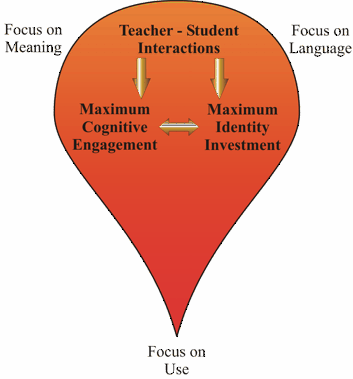
The central sphere in Figure 1 represents the interpersonal space created in the interactions between teachers and students. Within this interpersonal space, knowledge is generated (learning occurs) and identities are negotiated. In contexts of cultural, linguistic, or economic diversity, these interactions are never neutral: they either challenge the operation of coercive relations of power in the wider society or they reinforce these power relations. At the other end of the sphere, we can visualize the discourse of societal power relations which are broadcast into the classroom and directly affect how identities are negotiated between teachers and students. For example, the discourse that asserts bilingual children need to assimilate and give up their L1 if they are to succeed in the society is not a neutral scientific statement of fact; on the contrary, it contradicts the scientific data on this issue and derives directly from patterns of power relations in the wider society.
Within the interpersonal space of teacher-student interactions, students’ cognitive engagement must be maximized if they are to progress academically; similarly, conditions of mutual respect must be created that enable students to invest their identities in the educational process. If students are primarily involved in rote memorization in the classroom, only a fraction of their cognitive capacity is engaged in learning. Engagement of higher level cognitive processes such as analysis, synthesis, and evaluation —i.e. critical thinking— is clearly likely to produce much more learning for the simple reason that much more of students’ brains are involved in the process of learning. By the same token, this kind of stimulation will develop students’ brains, and their cognitive capacity, much more than instruction that involves only low-level cognitive processes. This clearly points to a major limitation of traditional orientations to pedagogy that focus primarily on low-level memorization and application skills.
There is a reciprocal relationship between cognitive engagement and identity investment. The more students learn, the more their academic self-concept grows, and the more academically engaged they become. However, students will be reluctant to invest their identities in the learning process if they feel their teachers do not like them, respect them, and appreciate their experiences and talents. In the past, students from marginalized social groups have seldom felt this sense of affirmation and respect for language and culture from their teachers, and consequently their intellectual and personal talents rarely found expression in the classroom.
In promoting academic language learning, it is necessary for instruction to focus on meaning, language, and use (Figure 2). Each of these foci is outlined below.
The Focus on Meaning component argues that the interpretation of the construct of comprehensible input must go beyond just literal comprehension. Depth of understanding of concepts and vocabulary as well as critical literacy are intrinsic to the notion of comprehensible input when we are talking about the development of academic language proficiency. This implies a process whereby students relate textual and instructional meanings to their own experience and prior knowledge (i.e. activate their cognitive schemata), critically analyze the information in the text (e.g. evaluate the validity of various arguments or propositions), and use the results of their discussions and analyses in some concrete, intrinsically-motivating activity or project (e.g. making a video or writing a poem or essay on a particular topic). In short, for learning of academic content, the notion of comprehensible input must move beyond literal, surface-level comprehension to a deeper level of cognitive and linguistic processing. Again, this depth of processing seldom occurs when second languages are taught within a traditional orientation.
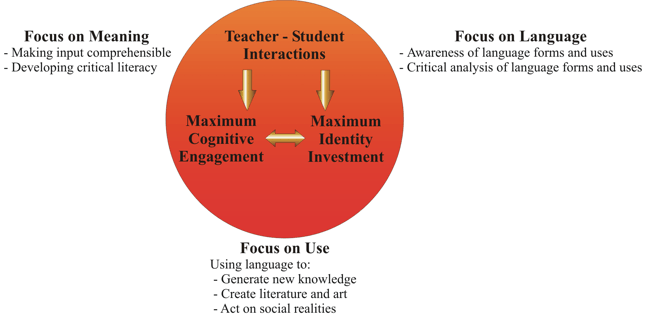
Figure 2: The Development of Academic Expertise
The following approach to developing critical literacy (Figure 3) attempts to show how interpersonal spaces can be created between teachers and students that encourage students to share and amplify their experience within a collaborative process of critical inquiry. Each of the five phases below progressively opens up possibilities for the strengthening of students’ personal and academic identity. The "texts" that are the focus of the interaction can derive from any curricular area or from newspapers, popular songs, or current events. The process is equally applicable to students at any grade level and the phases can be intertwined rather than follow a strict sequence. A basic assumption is that collective action to transform aspects of our social realities results in a deeper understanding of those realities.
|
· Experiential Phase. Activate prior knowledge and build background knowledge; For example, in a science unit on photosynthesis, teachers and students brainstorm on “What makes plants grow?”
Figure 3: Focus on Meaning: From Comprehensible Input to Critical Literacy
|
Much conventional reading instruction in both L1 and L2 has focused only on the literal phase or on comprehensible input in a very narrow sense. The experiential, personal, critical, and creative phases are essential if we are to speak of knowledge generation or transformative pedagogy rather than just transmission of information. These phases are described in more detail in Cummins (1998, 2000).
There is ample case study documentation that project-based learning can be greatly enhanced when students use technology to connect with people resources (e.g. a sister class with whom the project is being carried out) and information resources (e.g. on the world wide web) that provide access to multiple perspectives beyond those provided in the class textbook or potentially limited school library resources. These projects stimulate students to read extensively in a wide variety of genres and to process what they read in such a way that alternative perspectives are analyzed, inconsistencies identified, and problems resolved. Students gain access to comprehensible input and they use higher-order thinking skills to transform this input into critical literacy.
The Focus on Language component in Figure 2 attempts to put controversial issues such as the appropriate time and ways to teach L2 grammar, the role of phonics in reading instruction, etc. under the “umbrella” of Language Awareness. The development of language awareness includes not just a focus on formal aspects of the language but also the development of critical language awareness which encompasses exploration of the relationships between language and power. Students, for example, might carry out research on the status of different varieties of language (e.g. colloquial language versus formal “standard” language) and explore critically why one form is considered by many educators and the general public to be “better” than the other. They might also research issues such as code-switching and the functions it plays within their own lives and their bilingual communities. Or they might analyze letters to the editor on controversial issues such as immigration and examine how the language used in these letters positions and potentially stereotypes minority group learners such as themselves and their parents.
In short, a focus on formal features of the target language should be integrated with critical inquiry into issues of language and power. Also, to be effective, a focus on language must be linked to extensive input in the target language (e.g. through reading) and extensive opportunities for written and oral use of the language.
A number of scholars and educators have focused on the importance of developing language awareness not only as a means of demystifying language and how it works but also as a way of reinforcing students’ sense of identity. Lisa Delpit (1998), for example, talks about encouraging African American speakers of Ebonics (i.e. African American varieties of English) to become “language detectives” investigating similarities and differences between their own vernacular and other forms of English such as that found in school texts. For example, groups of students can work together to create bilingual dictionaries of their own language forms and Standard English. A significant goal is to reinforce students’ understanding that their language is legitimate and powerful in its context of use but that other forms of English are necessary in different contexts of use. Similarly, students in Greece might analyze differences between different varieties of Greek and the reasons why different regimes (e.g. the military dictatorship in the 1970s) favoured one variety over another.
Figure 4 outlines some of the activities that constitute a Focus on Language. These activities clearly go beyond just the teaching of forms and functions of the language. The goal is to develop among students a culture of inquiry into language and how it works in different social situations.
Collaborative Inquiry to Develop Critical Language Awareness:
Figure 4: |
Once again, IT provides a wealth of both people resources and information resources for students and educators working to develop critical language awareness. A good place to start in locating these language-related resources is the Human Languages Page (www.june29.com/HLP/).
The Focus on Use component is based on the notion that L2 acquisition will remain abstract and classroom-bound unless students have the opportunity to express themselves–their identities and their intelligence–through that language. In order to motivate language use there should ideally be an authentic audience that encourages two-way communication in both oral and written modes. The three examples of language use presented in Figure 2 (generate new knowledge, create literature and art, act on social realities) are intended to illustrate important components of critical literacy. Language must be used to amplify students’ intellectual, aesthetic, and social identities if it is to contribute to student empowerment, understood as the collaborative creation of power. Unless active and authentic language use for these purposes is promoted in the classroom, students’ grasp of academic (and conversational) aspects of their second language is likely to remain shallow and passive.
There is little question that IT can provide many of the essential components required to stimulate active written language use. Collaborative sister class projects, publication of student work on classroom or school web pages, or simply the use of computers to layout and print newsletters or other forms of publication all facilitate access to wider audiences than would otherwise be possible. IT can dramatically expand the communities of inquiry to which students have access and provide immediate outlets for communicating the results of students’ intellectual and artistic work (e.g. through school or class web pages).
Brown (1999), for example, describes a project dubbed “New Places” by the participating classes in which students who had moved to new communities described their experiences. Students who hadn’t moved interviewed peers at their school about how they were received in their new schools and communities. Students from a dozen countries were involved in this project, including those who had moved from rural China to Beijing, African Americans who had moved from the south to the north within the United States, and immigrant students who had moved from many countries to the United States. Students investigated what motivates migration and how people from different cultural, racial, and linguistic backgrounds were received by their new communities. Brown concludes:
One of the outcomes of this project was that together the students analyzed the linguistic, cultural, and institutional barriers at their schools and drew up guidelines for teachers and students about how to make their schools better places for newcomers. The idea that collaborative problem solving might make the world a better place motivates much online learning. (1999: 312)
As in many examples of sister class collaboration, the power of a project such as this derives from its dual and complementary focus on knowledge generation and identity negotiation. Clearly, depending on the sophistication of the equipment available to learners, video and audio components can be integrated into such projects but the essential pedagogical groundwork for this type of technology-enhanced transformative education was established in the work of French educator Célestin Freinet, long before computers were even dreamt of (see Cummins & Sayers, 1995).
A framework for computer-supported academic language learning has been outlined that views the interactions between educators and students as the most immediate determinant of student success or failure in school. These interactions can be viewed through two lens: the lens of the teaching-learning relationship in a narrow sense, represented by the strategies and techniques that teachers use to provide comprehensible input and reading instruction as well as promote content knowledge and cognitive growth; the second lens is the lens of identity negotiation which is represented by the messages communicated to students regarding their identities—who they are in the teacher’s eyes and who they are capable of becoming.
Instruction can increase cognitive engagement and identity investment when the power of IT is harnessed to connect students with sister classes in different cultural, linguistic, and geographical contexts. Students’ own identities can be expanded when they have to define aspects of their own reality to present to the sister class and when this reality is reflected back to them through discussion and project collaboration. Literacy is expanded in the process of carrying out joint projects for the simple reason that students read much more and write much more than when they are in an isolated, contained, non-communicative classroom situation.
So why then are we not seeing an explosion of sister class projects that maximize both cognitive engagement and identity investment? In North America, certainly, the technology is there but computers are as likely to be used for low-level drill and practice routines (traditional pedagogy) as for creative and challenging collaborative work (constructivist/progressive pedagogy). Transformative pedagogy projects are still extremely rare.
I believe the reasons have a lot to do with control and fear: the feeling among policy-makers and many parents that we need to exercise tight control over the curriculum so that what is taught will determine what can be thought. The other side of this coin is fear: fear that interacting with and getting to know the other will undermine our in-group identification and the transmission of our values unchanged to our children. Most societies still remain cautious and sometimes even xenophobic in relation to those from other cultures, “races” and religions.
It takes vision, courage, and confidence in one’s own collective identity to move from an education based on xenophobic roots to one that confidently embraces philoxenia understood as respect for and openness to the other. It also requires us to place critical thinking at the center of our educational philosophies and policies, rather than at the margins. James Moffett has expressed this challenge very clearly:
Currently, as educators we have the instructional tools to amplify students’ intellectual, linguistic, and moral development more powerfully than at any time in human history. The cognitive engagement and identity investment that is stimulated by sister class projects involving technology-supported collaborative critical inquiry is immense. But for this to happen, we have to build and continually refine explicit school policies that focus simultaneously on language, technology, and intercultural education. These policies provide maps that help us figure out how to get where we want to go. However, the real challenge is to figure out how much critical literacy and critical thinking we want our students to develop. As Moffett suggests, these are double-edged swords that, in any society, can be focused critically on our own inequitable social realities, myths of nationhood, historical omissions, religious beliefs, and cultural myopia as much as on “safe” technical problems. Do we have the courage as educators and policy-makers to fully promote collaborative critical inquiry or do we remain comfortably within the cocoon of the sanitized curriculum? The ways in which we use IT over the next decade will be determined by how we answer this question.
A Different Divide: Teachers and Other Professionals (Bonnie Bracey. Edutopia, Spring 2000, pp. 4-5. www.glef.org)